Thursday, 17 November 2016

Doctor Who - American Adventures

These collections of  themed Doctor Who short stories have been a lovely idea; books such as Tales of Trenzalore and The Legends of Ashildr have explored the fertile territory where the TV show left gaps. The latest collection (so far as I can make out, all written by Justin Richards) is slightly different; a collection simply linked by being set in the USA.

It’s a connection which often feels tacked on, with the collection often feeling like a series of generic Doctor Who stories which happen to take place in the same country (and in one case, not actually in that country). The periods in history feel like backdrops rather than thoughtfully chosen and the speech patterns of the characters we do get don’t distinguish them from European or Asian people. These are dashed off postcards rather than an interesting exploration of a British icon travellign through American history. At a push Taking the Plunge is the only one which really benefits from the setting; a fun idea which mixes theme parks and capitalism for what could be read as a subversive critique. The remainder of these adventures could have been set anywhere;  Off the Trail isn’t even set in the US and Spectator Sport’s connection feels like a contrived link to let the author use an idea he’s had sitting around. It’s a mild shame as there’s plenty of locations and events which, with a little more thought, could’ve made evocative and thrilling backdrops for stories.

This wouldn’t be so much of an issue if the stories weren’t generic too –mainly invasions with a couple of pieces of generic skulduggery;  all foiled in under 30 pages. The Doctor’s rarely unduly troubled by any of the adversaries he comes up against with the worst trouble he has being someone having to pass him his sonic screwdriver in a moment of crisis.  This means that all the stories feel a little pointless – without any real jeopardy the Doctor’s never tested and consequently they all pass by efficiently but without leaving a trace – to use an appropriately American metaphor it’s fast food Doctor Who: all perfectly entertaining while you’re reading them but very little that’s memorable afterwards.Received an ebook from NetGalley in exchange for an honest review.

The Descent of Man

I’m not sure I’d go so far as to nominate Grayson Perry for king and queen, as Caitlin Moran does, but I’d certainly nominate him for court jester. Court jesters are traditionally the ones who can get away with saying the unsayable in the presence of the powerful and that’s just what Perry does here.

Essentially this is Perry considering the traditionally masculine role in society with an artist’s eye; whilst the conclusions he reaches at the end may not be startling it’s how he reaches them that’s fascinating. What makes it so is Perry’s background; whilst his transvestitism and attachment to his teddy bear are well known his nearly joining the army and attachment to macho culture icons was less so. It makes for a fascinating mix; he’s able to discern the significance and iconic nature of clothing (though I suspect he goes a touch too far in the popularity of wearing jeans) and identify how the traditional masculine role has been eroded by social and technological progress. That’s best illustrated in the brief passage about the Durham Miners’ Gala, which he astutely observes as a kind of funeral of a way of life.  While it’s astute he also identifies it as a social problem; where’s the outlet for rugged masculinity and its rutting stags nature? That’s a question he considers but can’t quite find an answer to; the ritualised combat of sport only goes so far.

Ultimately Perry’s conclusion is a fascinating one; the need for a feminism for men which doesn’t descend to the fatuous mentality of ‘men’s rights’. Men, he concludes, would be stronger for being flexible, vulnerable and uncertain rather than taking refuges in lists, processes and the need to be right. ‘Men’s Rights’ is hankering for a nostalgic past of heroes, of right and wrong being easy choices.  Progress, he concludes, would be men embracing more traditionally feminist values just as feminism had absorbed and transmuted traditionally masculine ones. In a time which has often felt like a convulsion of traditional men striking back at social progress they don’t like Perry’s theories are convincing on the personal and social levels. Perhaps this book’s a step along the way to dealing with the issues modern masculinity can’t or won’t face and, in identifying them, dealing with them.

(Received an ebook from NetGalley in exchange for an honest review).

Thursday, 19 May 2016

Hillsborough


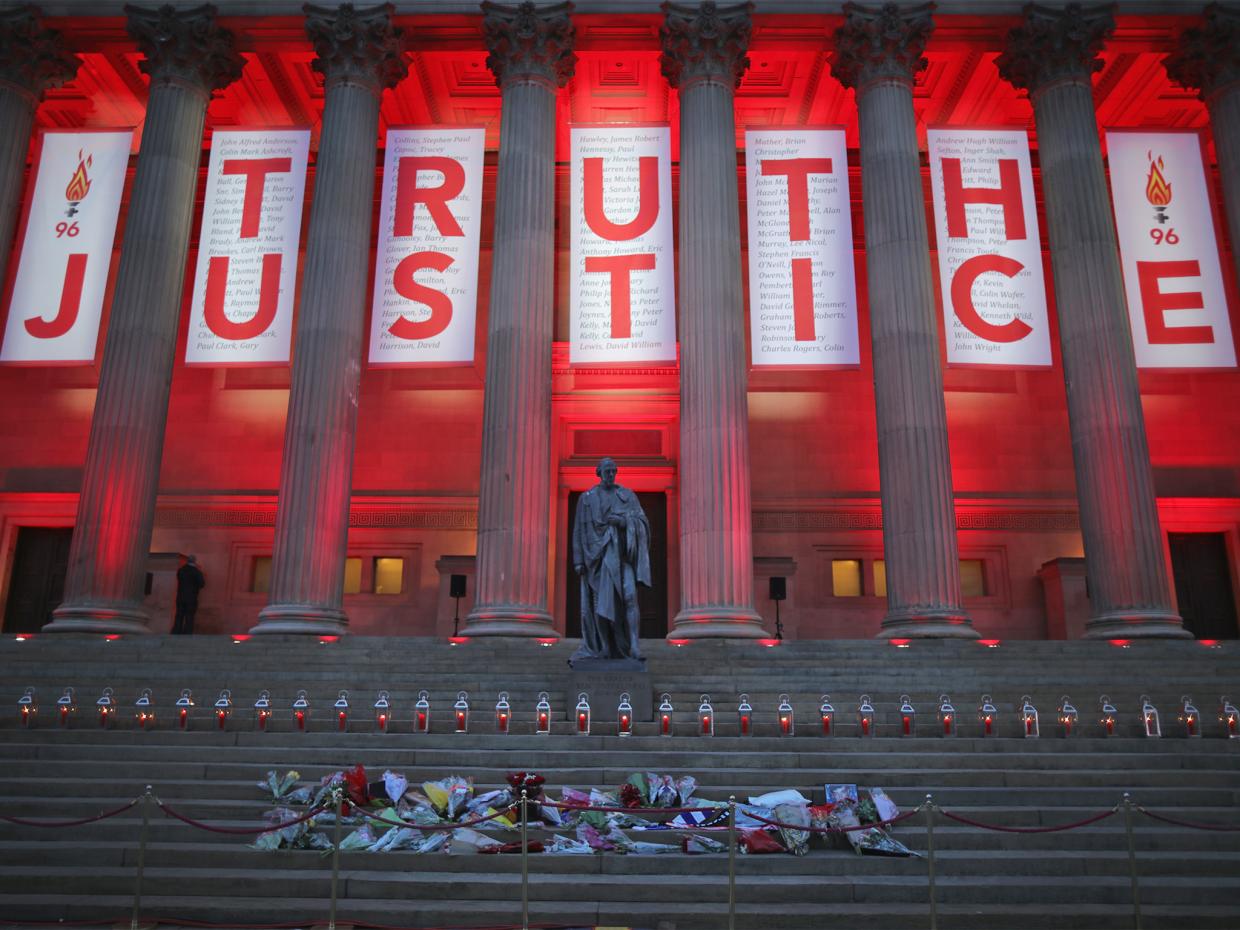
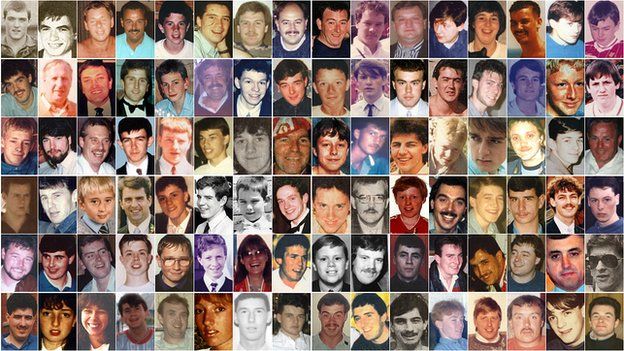
So I finally plucked up the courage to watch the BBC documentary about Hillsborough. It wasn’t a matter of being unprepared for what to expect; quite the contrary. I’ve read a lot of accounts of the day, the details unearthed by the Hillsborough Independent Panel and the outstanding investigative work of the likes of Phil Scraton and David Conn. The details of what happened remain harrowing beyond words; the descriptions of people crushed to death whilst watching a football match. They remain horrifying beyond the power of words to describe. The first hour of the documentary concentrates implacably on this; the confluence of circumstances which led to the deaths of 96 people. At each step in the process you can see where things happening slightly differently would have meant the terror of the day wouldn’t have happened at all; that it wasn’t inevitable. It’s a horror only real life could produce; miles ahead of the effect any filmmaker might achieve. Because it actually happened. Because a long chain of institutional incompetence and indifference led to the point where people died.

It takes as its starting point a police prank; a prank on a junior  for which the officer normally in charge of big matches in Sheffield carries the can and is exiled from Sheffield to Barnsley. Instead, for a big match an inexperienced officer who has no experience of policing big matches is brought in – disastrously, as officers on duty that day recount, he’s overconfident of his own abilities. The ground itself doesn’t carry a safety certificate; it had expired three years before the game and never been renewed. Spurs fans at the 1981 semi-final had experienced a similar crush but no notice was taken; nothing happened so things could carry on. That’s one area the documentary soft pedals; the Football Association’s responsibility. It selected the ground and gave Liverpool, the club with the larger number of fans, the end with the poorest access. It didn’t even bother to check the existence of non-existence of the safety certificate (as apparently no-one in the organisation understood the concept).  Liverpool’s chief executive Peter Robinson made protests against the choice of ground but, as four years earlier at Heysel, his concerns were ignored by authorities. If anything the conditions in the ground had been made worse for fans; the Leppings Lane terrace was not divided into three pens. That the word ‘pens’ is used tells you all you need to know about how football fans were regarded; as basically subhuman cattle, fit only to be fenced in. It’s a mercy that the suggestion of Chelsea’s reactionary chairman Ken Bates, that the fences separating fans from pitch should be electrified, was never taken up – what the casualties might have been if that had been the case is too horrifying to contemplate.

The thing that should be stressed at this point is a point made by the journalist Tony Evans (who was in the stands that day). That this was essentially a normal matchday; fans may have had one or two drinks before the game but there had been no serious traffic delays, nothing to cause a late rush of fans to arrive at the stadium. Yet thanks to the inadequate infrastructure of the ground a crush was beginning to develop outside the ground; an officer on the scene advised of the crush in no uncertain terms and that action needed to be taken. Sadly, with the inexperience of the officer in charge the most disastrous action that could be made was taken and a gate to the central pen of the Leppings Lane terrace was opened. At this point it should be stressed that the terraces were divided into three pens and the ones at either end were relatively underpopulated.  Under pressure an inexperienced officer made a very human mistake. And because of that mistake a crush developed on the centre pen of the terrace as fans rushed to get out of the crush outside the ground to try and catch a match which had already started.

I remember playing football on the street that day, running in at three o’clock so we could be updated on the first half and hear the second half in full (the radio rights only covered second half commentary of most games in those days). Instead we heard the game had been stopped after six minutes and Peter Jones, one of the great radio sports commentators, became a disaster reporter for the afternoon. It was horribly unclear at first; fans apparently spilling onto the pitch but as the afternoon continued the horror slowly unfolded. Pictures of the day now show that central pen; a seething mass of humanity full beyond bursting and with people still trying to enter behind.  It’s fairly calm and normal surrounding it; in the stand above and in the pens to either side. But the middle seethes like a bee hive that’s been attacked, a mass of humanity that looks impossibly tightly packed. John Motson even remarks on it in off-air comments; there’s no unruly mob rush, just a slow build of pressure. And what happened then remains impossibly horrific as Peter Beardsley hits the bar, the crowd naturally surges… people are packed so tight they can’t breather. Police officers recount how they can’t untangle the masses of limbs when they have to deal with the dead. All this time the initial mistake of opening the gate towards the central pen is compounded by inaction, by a lack of direction to open the gates that would allow exit. By total misunderstanding of what’s happening meaning that much of the police were directed to wait on the halfway line to stop a potential charge from the Forest fans. Some police help but it’s the other fans who help; the ones sitting above dragging people out, passing others over the fences, improvising stretchers… the human desire is to help. And the police at that end, when they realise what’s happening, also help desperately, attempting to save lives and get people out. Common humanity prevails, even if the official response remains inadequate with ambulances unable to reach the ground. It’s then a tale of coping with chaos and of relatives trying to discover what’s happened to loved ones. The documentary managed to clearly portray the chaos and horror of the day.

The conjuror’s trick lies in getting you to look where he wants. You know ‘look into my eyes; don’t look around the eyes…’ Their art, fundamentally, is misdirection and getting you to mistrust your own sensory evidence. It’s also the art of the PR man and advertiser, to get you to believe what they want you to, whatever you can see. The Hillsborough cover-up beings excusably; with the officer in charge on the day wanting to cover his own backside. It’s not pleasant, but it’s a human reaction. The fatal opening of the gate became an issue where it was forced by fans, not by police order. In a sane world this lie would soon have been uncovered and exposed by any remotely competent investigation. Instead it became a point to begin an institutional cover-up that wasn’t fully exposed for nearly three decades, blame dodging by the organisations which failed in any conception of a duty of care to the fans; the South Yorkshire Police, Sheffield Wednesday FC and the FA. The police, with the connivance of the local MP, began by blaming ‘tanked-up yobs’ for arriving late and causing the congestion which led to the crush. They compounded this with details of bodies being robbed and the police being assaulted and urinated on when they were bravely attempting to help. Liverpool fans, like any other set, are no angels, as is acknowledged, but viewing any footage of the day provides no evidence of such behaviour whatsoever. Quite the opposite; tragedy begat natural nobility rather than venal or aggressive instincts.  It was fed via the local press association to national papers and widely reported. Most had the sense to frame them as unproven accusations; the editor of The Sun infamously declared them ‘The Truth’. As facts. That’s why the line from anyone asking why The Sun bore the brunt of Merseyside fury when everyone else reported the accusations is worthless; because only The Sun reported them as facts, a decision purely down to the editor. Again, Tony Evans points out that the first question a journalist should ask when considering whether these were truthful accusations is whether you’d do such a thing yourself; it’s almost impossible to imagine that any sane person would. It speaks volumes of the government of the day and the type of figure within it that one of them declared it to be the fault of tanked-up yobs; an accusation he’s never seen fit to retract despite it being challenged officially several times and always found groundless.

It was Lord Justice Taylor’s inquiry that first found it baseless. A subsequent coroner’s enquiry found the whole affair to be an accident; but this was another part of the cover-up with the coroner unscientifically declaring a cut off of 3.15 when considering time of death and causes of death.  It was another aspect of establishment cover-up; a backroom deal that the South Yorkshire press officer tried to declare the end of the matter.  An accident, of course, would mean that it was something that couldn’t ever have been foreseen or prevented without great foresight. Again, this was a great evasion of blame on the police’s part, but one apparently backed up by evidence from officers on the day. The reality was quite different. When Phil Scraton gained access to the statements from officers he found they’d been significantly altered to remove any criticism of police conduct on the day. One officer in the documentary recounted that the police officers of the time carried a little blue book; something sacred in which you recorded what had happened on the day, however minute. And yet… when they were being debriefed afterward they were told not to worry about this (creditably, one experienced officer when told this said to his colleagues to ignore that and record everything down to when they’d last used the toilet). This wasn’t unprecedented; the government was well aware that it needed the police support to survive pushing through unpopular actions and policies and as such had ensured the police became well-paid and backed-up in any investigations. South Yorkshire Police had form; after the notorious incident at Orgreave during the miner’s strike of the mid-1980s the government had backed them up and fed stories of rioting miners rather than investigating stories of police brutality. All this, naturally, led to a total lack of accountability which should be vital to any law-keeping institution.  But there was no accountability. The deaths were declared an accident, the reputation of Liverpool fans were tarnished; the vile element of opposition fans provoking them with chants of ‘always the victims, it’s never your fault’ when Hillsborough was piled on top of the earlier Heysel tragedy (and in the interests of balance, certain elements of Liverpool fandom weren’t shy of replying with equally distasteful chants relating to deaths for other clubs). That it was all so easily believed; that the late 1990s would see it declared as useless to reopen a file on the case with no new evidence compounded a sense that the establishment had closed ranks and shifted the blame to what they seemed to view as a subhuman mass of fans.

Subhuman isn’t too strong a word there; English clubs were banned from European football for hooliganism; many city centres were damaged by fights between fans in the 1980s. The Prime Minister didn’t understand competitive sport or spectators; therefore she was all too ready to believe the worst of their behaviour (as were many members of her Cabinet).  I’ve mentioned the Chelsea chairman’s proposal for electrified fences; measures taken only in terms of extreme security or fencing in cattle. Equally when questioned on the matter the FA admitted that no-one truly understood ground safety; no-one had even undertaken basic checks on the ground before it had a semi-final allocated. No-one listened to Peter Robinson’s warnings based on the semi-final of the previous year and the Spurs-Wolves game of earlier in the decade. No-one at Sheffield Wednesday cared enough about fans to ensure their ground was safe; if there was one positive thing to come out of that day it was the Taylor reports recommendations on improving ground safety. All this has one thing at the heart of it; a snobbish lack of concern for those with less money or whose pleasures are considered less highbrow. Hillsborough wasn’t inevitable; not until extremely close to the tragedy happening. But with those prevailing attitudes something like it was inevitable.  Tony Evans point that it wasn’t a particularly exceptional day, that very little happened to cause the tragedy that didn’t normally happen on any matchday, is the key point. With those attitudes it was inevitable that something like Hillsborough would happen sooner or later. It may not have happened at Hillsborough; it may not have been Liverpool fans but sooner or later the total lack of concern for fans, for paying customers, meant that there would be crushes and that sooner or later mistakes would be made that meant people would be seriously injured or die. It was really a matter of time before some kind of tragedy occurred.

This, of course, is not thinking that would permeate establishment minds. As with most humans we’re locked in our own worldviews and don’t question them, instead fitting facts and events to them rather than letting inconvenient facts amend our perceptions. If the insistence of a terrible accident was made for long enough all this would eventually subside. And it nearly did; a private prosecution against the officer in charge of the day failed as it provided only a hung jury; funds raised by organisations supporting the families of the bereaved in the quest to find out what had happened to their loved ones seemed wasted on that failed case. But at a memorial service at Liverpool’s home ground of Anfield Cabinet Minister Andy Burnham was confronted with a wall of anger as he spoke and expressed official sympathy; creditably he took that on board and insisted on the case being reopened. Eventually that led to a two year long case which ended up utterly exonerating the fans and finding that official institutions had failed them dismally. Every death at Hillsborough was ruled an unlawful killing. The police and Sheffield Wednesday were at fault. The FA, which had issued a non-specific apology a few years earlier, kept very quiet. Sheffield Wednesday had failed in their neglect of their ground. It took more than twenty-seven years for the dead to be exonerated and for actual facts to be established; facts the police had even tried to deny in the courtroom. The Kop singing You’ll Never Walk Alone at a match is a grand and joyous thing but it was as nothing compared to the joy of the families being able to sing it on the steps of a nondescript modern courtroom after the verdicts were announced. Because the details that haunt you aren’t just the descriptions of the carnage on the Leppings Lane terraces; nor the police officer (and ex-paratrooper) involved in rescue efforts on the day suffering a nervous breakdown whilst on duty in his car. It’s the hair; grey, white or gone. It’s the lines time has etched onto their faces; grief and struggle against institutions which let them down. It’s the steel in the eyes; that anger and grief has been forced to fester there whilst the names of their family were dragged through the mud. That it took twenty-seven years to undo a lie originally spread in minutes. That justice took so long to serve some of those who got away with it lived out comfortable lives and died with their sins unaccounted.  Twenty-seven years; not far short of ten thousand days. After watching the testimonies of the officers and fans you suddenly realise the importance of proper accountability and that there was no accountability whatsoever should make anyone deeply afraid. Because if there is no accountability in a situation so obvious, where evidence was clear… when can you trust any institution? How many people in power are actually fitted to it? When can you ever trust an institution again? The financial crash and subsequent actions of financial institutions certainly suggest the answer remains: ‘you can’t’. Hillsborough didn’t only cost 96 lives, it cost decades of other people’s lives (and contributed to many early deaths of those involved in the search for justice). And in the long term it cost a community their faith in society. It’s never a bad thing to learn to question how power is wielded but in the long run that lasting distrust is the establishment’s price for the short term saving of a few reputations.

So yes, I’ve had my heart broken and been rendered furious once more by it. It’s an astonishingly powerful film; almost as powerful as Jimmy McGovern’s 1996 dramatisation of events. If you’re remotely squeamish of strong emotions or descriptions then it may be unbearable but for those with a strong enough constitution it’s vital. Not just if you’re a football fan, or remember the game, but as an expose of a tragedy and how easy it was for the responsibility to be pinned on the innocent. Ultimately it tells you that in times of crisis you should put your faith in the quality of fellow human beings rather than in any uniform they wear or any power they hold. And that if you fight long enough and hard enough, eventually any lie can be undone.  There’s no triumph in the verdicts; it’s simply the treatment of a festering wound that can finally be allowed to begin to heal. The tricks of the magicians have been explained and exposed; the charlatans are undone and all that’s left is the accounting. Maybe, just maybe, the institutions of society can be made to work as they should eventually. And 96 victims can rest in peace.


Thursday, 17 March 2016

Infinity On High (The Lost Time Accidents)


I’m a sucker for novels which treat genres as a game and run rampant, laughing at the idea of easy classification. This is such a novel, a confident melding of science-fiction, an intergenerational family saga, physics, mystery, satire, history and even a classical form of tragedy. We’re dropped in at the deep end, meeting our narrator Waldemar Tolliver who’s engaged in writing a history of himself and his family in an unusual setting in terms of both space and time. The enigma of just what constitutes lost time accidents begins with Waldemar’s great grandfather and a note he leaves just prior to a fatal car accident. This note is the novel’s MacGuffin, inspiring the members of the family to a kind of century long collective madness and one which sets them up in direct opposition to a physicist known to them by the disparaging nickname of ‘the Patent Clerk’. The novel unfolds their opposition to Einstein’s theories at leisure, being careful for much of its length to leave it to the reader to decide whether it genuinely works in context of the novel’s world or whether it’s a delusion related by an unreliable narrator.

It’s this strange theory which allows the author to get at the issue at the novel’s heart; how we’re the physical and psychological product of our ancestors and the recipients of their hopes, fears and neuroses and what that means for us. The ultimate fate of our narrator indicates that, even if we might physically step outside that, we’re largely stuck with the weight their inheritance bestows upon us, unable to escape our family. Family ends up being destiny, determining our way. It’s something of a downbeat thought but one the novel powerfully realises, particularly with the last few lines which, if you’re paying attention, complete the tragedy and the theme of tragic circularity. It might be trying to make a grand statement that’s been made by other contemporary novelists but it wears that gravity of Trying To Say Something Profound lightly; wrapping it up with a comedy, tragedy and a host of interesting and entertaining characters. The events these characters go through are always unlikely but the fascinating kernel most of them have keeps things grounded – the weird aunts, the cult leader, the Nazi great-uncle and the unwilling L Ron Hubbard of a dad are all believable, convincingly motivated human beings who contrive to struggle fruitlessly in the web of their family’s mania. They’re rarely likeable as we can clearly see their faults (often through Waldemar’s eyes and even his narrative exposes his flaws) but Wray’s exceptional at understanding the way people are broken which makes them interesting and portraying that. Thought-provoking, absurdist, challenging and ladled with great lines understand that the impact of a good punchline derives in part from how the joke is told.


(STANDARD DISCLAIMER – The copy I read was an advance eBook provided gratis by NetGalley in exchange for a fair and honest review).

Tuesday, 15 March 2016

....and it was a gas


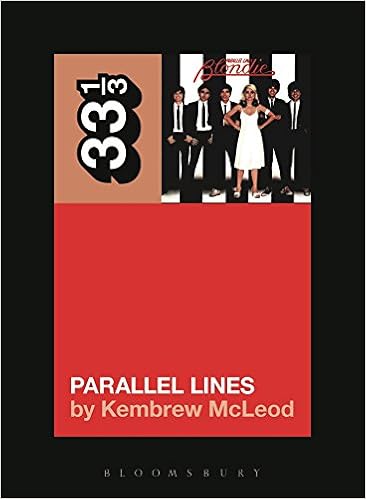
New York of the 1970s was one of those scenes; a thriving, vital hotbed of freaks, dropouts and weirdos getting artistic whilst the Big Apple rotted around them. It started roughly with the kinky subversion of Warhol and the Velvet Underground and would end up manifesting itself in a myriad of forms; Patti Smith’s punk poetry, the geek funk of Talking Heads, the rampant sleaze of the New York Dolls and the heads down ramalama racket of The Ramones. Even the musical forms which ended up being culturally dominant (disco and hip hop) began as the songs of the marginal. Blondie’s Parallel Lines is a document of that scene; a record of how it grew, evolved, splintered and eventually how it was refracted in one of the finest and most stylish pop albums of all time.

Very little of the book focuses on the album itself; perhaps only in terms of what Mike Chapman brought to producing the album and how remarkably the album was broken by the fourth single; a song buried halfway through side two. In modern times it’s insane to think that a song which still sounds like it should be an instant pop smash was almost sneaked out apologetically. It’s a wise move on McLeod’s part; he’s correctly divined that whilst Parallel Lines is a magnificent pop album what really makes it interesting is how it messes with what pop should be; you can enjoy Harry’s femme fatale persona as performance act or simply as an iconic pop star; you can enjoy the ridiculously infectious songs or enjoy the subversively provocative lyrics; you can enjoy the album or marvel at the sources it’s drawing on. It’s a melting pot of New York influences; punk, power pop, disco and they’d even stir in hip hop later on. In many ways they were as magpie as Bowie but playing with a 50s trash aesthetic rather than sci-fi and mysticism (they’re minor strands in Blondie’s music). Further parallels with Bowie come in Harry’s awareness of the power of image; the band’s at its strongest when Harry has control of the visual imagery. Harry and Bowie share an instinctive understanding of the importance of image and presentation in pop; something they were ahead of the game in as they broke through in the pre-MTV era. What’s really treasurable is how the book reminds us that it’s an underdog story; how no-one thought Blondie would make it let alone be the most commercially successful band of the scene.

The whole thing’s laced with the interviews from important people in the story; the band members themselves and those around the scene at the time. It doesn’t shy away from less glamorous aspects of the band’s story (the money troubles, the state of the area they lived in, the sex and drugs, Chris Stein’s illness) but it’s all covered compassionately and with proper context.  And that’s the triumph of the book; to put the band and album in context of the scene it came from; in its importance in the band’s history and the little tricks they were pulling beneath Chapman’s immaculate pop sheen. A sharp enjoyable tribute which fills in the details lost in the dazzle when the spotlight hit the glitterball.


(STANDARD DISCLAIMER – The copy I read was an advance eBook provided gratis by NetGalley in exchange for a fair and honest review).

Dance Songs '97


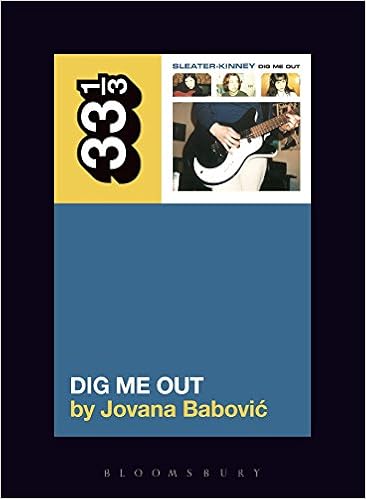
I love Sleater-Kinney; they’re one of the last bands for my generation that you could fall in love with, who could mean the world to you and who would who loved the fans as much as the fans loved them. They always seemed aware of the fan reaction and the political statement of being three women playing fast, often angry music. They seemed to want to be the feminist equivalent both the Sex Pistols and the writers of Sniffin’ Glue.  It’s a beautiful ambition. I love that the album Babovic has chosen for the 33 1/3 series is Dig Me Out; whereas Call the Doctor and All Hands on the Bad One feel more obvious choices Dig Me Out is where the ‘classic’ line-up coalesces and things began to take off for them commercially. It’s a portrait of a band on the cusp of their big artistic and commercial break; almost invariably it’s the most interesting point of any band’s career. Even Coldplay’s.

As with the best books in the series this is barely about the album itself; although the circumstances of recording are discussed as they’re important to the record’s mood Babovic wisely realises that the technicalities aren’t important and often the album itself isn’t either. It’s simply the cultural artefact that triggers everything; the eye of the storm. As with the last 33 1/3 I read (Blondie’s Parallel Lines) this is about putting the album into context; its roots, its reception and the consequences for the band and music in general. I’d perhaps have liked a little more on Riot Grrl (although I appreciate there’s not a great deal of room to discuss it a little more beyond depth beyond Bikini Kill would’ve been nice) but Babovic drills down to just why the movement made little impact outside its heartland of Washington state and the UK but Sleater-Kinney did. It’s perhaps a simple conclusion but it might have been interesting to see it linked to Nirvana and Cobain’s inability to marry his purist ethic to grand scale success.   Not comparing female rock stars to male stars is very much the point but equally the comparison could simply be made band against band. Riot Grrl wasn’t equipped to handle mass success but Sleater-Kinney’s willingness to meet mainstream press and the music business whilst maintaining their principles means they were. You can’t spread a message, no matter how worthy, with an insular attitude. My favourite part of the book remained the details of the interactions of fans and band; the late 1990s and early 2000s feel like the last hurrah of fanzine culture and it’s fantastic to see it detailed here. Hey Soundguy sounds like the DIY punk zines of the late 1970s; a love of music (not necessarily technique) combined with a willingness to expose the workings of the system.  It’s about artists genuinely interested in having a conversation with their audience rather than preaching at them; that’s my favourite kind of band and a reminder of just why I love what they mean as much as any individual song or album.

If there’s a minor fault it’s perhaps that Babovic lapses into dry academic tone occasionally but it’s not at the expense of clearly dealing with the issues surrounding the band; it’s clearly as much about using the language of rock criticism to communicate as the band were using musical language to get their point across. That very much feels like the right way to write a book about the band; it covers what makes the band important in a relatively small wordcount.

And now I’m off to play Dig Me Out loud and take myself back most of two decades. Driving you back to the album is always the best sign of a good book.


(STANDARD DISCLAIMER – The copy I read was an advance eBook provided gratis by NetGalley in exchange for a fair and honest review).

Thursday, 10 March 2016

Tuesday, 1 March 2016

Volcano Day!

Well, book release day anyway.


Along with the three other excellent titles in the series Rose is now available as an ebook from the Obverse website, along with the other three launch titles. I'd recommend waiting for the very sexy print editions but if you want to save a few pennies/are impatient/don't want to fork out for postage run, don't walk, Obverse's way and throw your pounds and pennies at them. Throw them enough and they'll do a funny little dance too.

Plus! Details released of the first two books in the monthly schedule: Simon Bucher-Jones's study of Image of the Fendahl and Jonathan Dennis's take on Ghost Light.  The summaries for both of these should have you slavering in antici...


...pation and wanting to throw more moolah Obverse's way.

Don't let me keep you; please go and make some authors, the editor and the publisher happy little elves.  Thataway!


Friday, 26 February 2016

Examining The Black Archive

The first Black Archive reviews are in and pretty damn fine they are too.  Sci-fi Bulletin has reviewed each of the first four titles:

Rose

The Massacre

The Ambassadors of Death

Dark Water/ Death In Heaven

And gentleman and scholar Nick Campbell has a further look at The Ambassadors of Death here.

Obviously, after reviews like that you'll be wanting to pick up a full set so here's the handy dandy link to snaffle all four of the launch titles.

Sunday, 21 February 2016

Exercises in Twitter Futility, Part 3,286 in an infinite series

Presented as a cautionary tale to the curious to warn about the futility of wasting your life:  I had one of those moments this week; the sort of moment the Total Perspective Vortex from The Hitchhiker’s Guide to the Galaxy is supposed to bestow. The moment you realise we’re just a bunch of squabbling apes on a rock spinning around a big ball of fire in the middle of a big void. Being mildly bored I was browsing through Twitter when a friend retweeted Louise Mensch’s comment about being pro-Brexit pointing out that she lived and worked in America.

(Incidentally, what poverty of linguistic imagination cooked up ‘Brexit’? A play on a smashed up compound word that barely worked when applied to Greece but at least you could see how it got there)

Rule One of Twitter. Don’t Tweet bored.  Drunk is fine, drunk tweeting can be hilarious but tweeting out of boredom is the road to hell.  I’d forgotten that Mensch is practically a right-wing parody account; no idea what she’s like in real life but she’s rabid comedy gold on Twitter. Living in Northern Ireland and having certain EU statutes underpinning the Good Friday agreement I’ve got something of a vested interest in the EU referendum; I was curious as to why someone who lived and worked outside the EU by choice was so agitated about it. So I asked her about it, like so:

https://twitter.com/The_Arn/status/700670828468305920

Yeah, I know. You can see where it’s going.

First response no problem. She explains in service of making her point.

https://twitter.com/LouiseMensch/status/700671221092872192

No problem with that at all. Then she starts being sarky:

https://twitter.com/LouiseMensch/status/700671394653216770

Good one. I wasn't aware of that, I thought it was all one way traffic with hordes of emigrants looking to escape the dreaded tyranny of the EU.  The next one tickled me the most though:

https://twitter.com/LouiseMensch/status/700671636446445568

'Little EUnglander'. I've not read one of her novels but it's possibly the worst attempt at wordplay in recorded history.  Which is pretty good for two words.  Let's run through the genius of it. 

  1. 'Little'. The EU is not little; certainly not in comparison to the UK. I'm still trying to work out how being pro-Europe is being small-minded in comparison to wanting to retreat to being a reasonably sized island nation at a point where the important world forces are global rather than national. What's small-minded about seeing yourself as part of a larger community than just your immediate neighbours?
  2. 'EUnglander.'  Come on. It doesn't work on any level as a pun; it doesn't scan nor can it be crowbarred to form an amusing play on Englander or EU... erm, citizen. 
  3. No way Mensch could have known it but I'm not English. Neither by birth nor residency. 
It's also stretching it a bit to say that a lot of people live and work in many countries.  It's a touch arrogant to assume that; many professions don't involve working abroad.

All this of course didn't answer my question; which was very kindly put succinctly by another user: 


And when I realised I wasn't going to get any answer, maybe a little more invective at best, I walked off; frankly that's as wise as it gets. Would that I'd realsied that half an hour earlier.  And I realised that I was getting a bit too invested in the EU debate when there'd be four bloody months of it and, quite honestly, I wasn't going to get anything to tell me why changing the status quo would be a wise idea.

And now I've wasted half an hour of my life talking about a minor conversation with a minor political celebrity on Twitter. I'm beginning to understand how easy life is for journalists these days; bored chat on Twitter, 500 words in half an hour, job done and down to the pub. Good life it you can get it...


Saturday, 20 February 2016

The Black Archive Blog: Why Rose?

With the launch of the first four Black Archive titles imminent a blog about my entry on Rose; to explain why I chose it and the thinking behind my approach.  None of the actual analysis though, you'll have to give the frankly sexy and beautiful Obverse Books your cash to get that...  


Originally I was thinking in terms of my favourite stories; a fair number of them being those that congregate around the top of the polls along with more idiosyncratic choices (I pretty much considered every McCoy era story aside from Time and the Rani).  I soon realised that it was the wrong angle to approach such a choice from; it’s not your affection for a story but how much you have to say about it that counts. In that sense a lot of the most interesting stories aren’t the most successfully realised but ones where ambition has clearly exceeded grasp.  So I scrapped my original train of thought and cast around for ideas.

The final choice of Rose was partly a question of timing and partly a question of what the story meant to me personally.  The first solicitations for The Black Archive series took place in early 2015 and the early part of the year naturally saw a lot of material about the tenth anniversary of the new series with Rose being a particular focus. Most articles swerved between nostalgic and adulatory but few really analysed just *why* Rose had been so successful.   It’s the start of the mythologizing of the RTD era; it’s distant enough for the details to blur and it to become part of the show’s history. Rightly so too, in Doctor Who production terms ten years is forever; there are vast differences between An Unearthly Child and The Time Warrior or The Horns of Nimon and Survival. We’ve had four season of RTD and five of Steven Moffat plus numerous specials since that first episode. Much of the analysis had a narrow focus too; on the episode itself rather than the wider context of the TV landscape or why creative decisions made by Russell T Davies and those involved in the production of the show ended up being spectacularly validated.  I was looking  to put what was achieved with Rose into the context of the show’s own history and the popular culture of 2005.

On the personal front the episode meant everything to me as a fan too.  It catapulted the show back to the heart of British popular culture to the point of it being a default reference when talking about SF; to add to the excitement the production of the show was based five minutes from where I was living at the time. I passed the studio every day on my way to and from work and even saw Eccleston and Piper rehearsing outdoors in late summer.  For a long-term Who fan the combined thrill of proximity and success was something it was difficult to put into words.  The pinch yourself wonder of having Who back; not only having it back but having it back on Saturday night and achieving ridiculous ratings.  I wanted to capture that thrill in the book; the essence of success that we’re all quite blasé about in the wake of the show’s subsequent success.  I said earlier that much of what’s interesting about Doctor Who are the heroic failures but Rose is an exception; in terms of what it sets out to achieve it’s unarguably the most successful episode in the show’s history.* Not only in terms of the initial impact in its own country but it’s the most frequently bought drama of the past 40 years for BBC Worldwide. More successful on that front than Eastenders, Howard’s Way, House of Cards, Dennis Potter’s most acclaimed works, State of Play, Tinker Tailor Soldier Spy, Call the Midwife, Happy Valley, This Life, Casualty, Our Friends In the North… It appealed on a national and international basis.  What was fascinating about it was why it had such universal appeal; why the revival of a 42 year old series struck such a chord.

With that overarching theme of the rebirth of the series in mind I sent Phil a proposal for the structure of the book; what seemed the most fascinating aspects of the rebirth.    He agreed them with minor modifications and some excellent suggestions for further investigation.  In keeping with the tone of the new series I was aiming to blend my analysis with a relatively light tone; reflecting the story it examined.  


Fast forward to December and just before Christmas and after some excellent feedback from beta readers (thanks, in particular to Geoff Wessel for a couple of excellent points), a some thoughtful notes from the editor which added clarity to certain areas, depth to others and generally tightened the manuscript it was ready to be sent to the publisher.  Fast forward another couple of months and you’ll see an author bouncing happily up and down after having seen the gorgeous cover artwork from Blair Bidmead and Cody Schell and having read through the beautifully put together ebook.

At the time of writing the first four volumes in the Black Archive series are at the printers and on target for their early March release date.  It’s been a privilege to be part of the launch of a series I’d be delighted to read even if I wasn’t involved; quite aside from my own title I've read an early draft of Dark Water/Death in Heaven (a breathtakingly fine set of essays) and I can’t wait to read The Massacre and The Ambassadors of Death both for the stories chosen and the authors.  Similarly the remainder of the year promises a strong selection of writers and stories which I’ll be pre-ordering. You can give Obverse your money for the first four titles here,


Now all that’s left is the always nervous wait to see what everyone makes of it.  Time to see if fingernails can be gnawed down to the bone then…


* Not necessarily in terms of the actual episode but in successfully relaunching Doctor Who.  There's a decade's worth of TV, spin-offs and foreign sales on my side here.

Hating to Love

Don't tell anyone, but I might well know something about a few of the essays in this very fine forthcoming volume...

Friday, 12 February 2016

The Black Archive Is Almost Open...

Well here's a thing.  A rather beautiful thing at that...


In case you're one of those souls whose eyesight is going due to decades spent staring at TVs or monitors it's the rather fabulous cover for the first of the Black Archive series the first four of which are released next month but available for pre-order from the modestly magnificent Obverse Books either on its own or as part of a bundle of the first four in the series.. Obviously I'd be obsequiously grateful to anyone good enough to but the book but I thoroughly recommend buying all four. 

The cover's a collaborative effort from the insanely talented pairing of Blair Bidmead and Cody Schell and you can see this and the three other spectacular covers on the Black Archive Facebook page or here. I'd say I'm absolutely delighted with it but that might be considered a ridiculous degree of understatement.  It's currently the wallpaper on my phone and I'm starting to consider texts and notifications which stop me admiring it in a near-hypnotic trance rude. 

I'll blog about this in more detail closer to the release but in the meantime keep an eye out for further announcements on the above Facebook link and feel free to get very excited at how damn fine this series is going to be.

Wednesday, 18 November 2015

The Joy of Having Written

It's just over 24 hours since I completed the first draft of the Black Archive for Rose and I sent it to the editor.  That's my first solo book off to the editor I have a little indie champagne* to celebrate and...

...got back to that there writing today, a ghostly short story for a friend.

That's how proper writers roll isn't it?


* Jack 'n' coke

Monday, 9 November 2015

More Me...

Not only is there upcoming work but there are also a couple of other things that I've written that have come out over the past month.

Firstly the very fine Two Unfotunates website asked me back to contribute an entry to their Football Cities series - my entry on Liverpool can be found here.  It's very much worth your while to investigate the full Football Cities series and peruse a lot of very good football writing on the rest of the site, including some chancer contributing a review of David Peace's Red Or Dead. 

Also recently released, I've contributed to a new anthology from the Cygnus Alpha collective, Secret Invasion.  It's the brainchild of the talented Tony Eccles, and the high-concept essence is 'Lovecraft in South West England'.  Tony asked us to find a suitable location in which to set our story and build from there.  Mine's set in the bleak, beautiful wilds of Bodmin Moor and takes in the ideas of holiday homes, what happens after a career in the City which might burn you out young and what sort of creature might not like to be disturbed by foreign interlopers. You can get an eBook for your e-reader of choice by donating to the fine charity MIND here or you can procure a hard copy in one of three versions ranging from a standard softcover to luxurious hardcover here.

(Art by John Swogger, not to be reproduced without artist's permission)


The Black Archive is opening...


So this is an upcoming thing...


Phil Purser-Hallard, one of the smartest people I have the pleasure of knowing, came up with a simple but brilliant idea for a range of books; in-depth studies of single Doctor Who stories by a bunch of talented writers with interesting things to say. I've got the pleasure of being included in the first batch of books with a piece on the episode that launched Doctor Who back to the heart of popular culture.  Think the Doctor Who equivalent of the excellent 33 1/3 books.

These are going to be magnificent.  Further details here and whilst you're there you really should open your virtual wallet for a few of Obverse's other fine books.

Saturday, 26 September 2015

There are poppies

I’m sitting on a bench, just behind a garden I used to play in.  Technically it belongs to the neighbours, but they’re fine with this.  It’s a small garden space, with a sheep pen to one side.  The sheep are docile, and will happily let you scratch behind their ears for hours if you’re prepared to.  They belong to the couple who’re about to move in to this property.  But it’s an open expanse of green; it’s a nice space which isn’t enclosed with a high fence but a large enough fence to delineate the property.  This is a house in a rural village, not particularly worried about blackguards and rapscallions jumping over fences in the night to commit vile or mischievous misdeeds.  And it’s a lovely sunny day, summer turning into autumn with an occasional cool breeze rudely interrupting the lazy warmth.  It’s one of my perfect times of the year.  And there, in the middle of this open, green space three poppies catch my eye, almost rudely intruding on the meditative powers of this space and almost demanding attention with their vivid redness despite their relatively small size. And with it I feel hope, poppies being a symbol of memory and life growing even from death.


I’ve come here to gather my thoughts after my gran’s funeral.  It’s been a fitting send off and celebration of her life as it should have been.  There’s been little sadness; she lived a good long life of just under 95 years and was active and independent right up to the end and her death was a merciful end after a stroke led to bleeding deep in her brain.  Each of us who mattered to her – both her daughters and their husbands, we four grandchildren and a few other friends and family – got to say our goodbyes, even if she could barely speak.  The end, when it came, was a mercy and, by bizarre coincidence, on my other gran’s hundredth birthday.  A day or celebration and mourning, though the birthday party was a definite tonic after ten days of waiting for an inevitable end.  The funeral has gone as magnificently as it can; we four bearers (three grandchildren and one of her neighbours) have supported her into the church, we grandchildren have managed to deliver our tributes without cracking and we’ve all been able to remember the joy of her life and pay tribute by singing her favourite hymns.  And afterwards we retired to the British Legion clubhouse over the road where a splendid spread awaited.  With gran you’d get nothing else, Welsh grannies would never knowingly see you underfed ever from the afterlife.

In truth I did nearly well up a few times before the service whilst we waited at her old house.  Wandering through a place filled with the happy, secure memories of childhood, ornaments and artefacts imbued with memories and reading cards and tributes from everyone who’d known her.  You know what she meant to you, but you can’t know what she meant to others. And all the memories spoke of joy, even if derived from a tough life.  By the age of 21 she had a premature child to look after and a senile father to cope with and all without the presence of her husband who’d been called away to the war efforts in India, Iran, Iraq and eventually up through Italy.  In the week leading up to the funeral we’ve been going through his old photos of exotic, long gone places, experiences we could have never known.  Those photos range from boy kings to executions of criminals, though of the most significant event he was present at there is no record (the stringing up of Mussolini).  We never heard from our grandpa about these events and even those closest to him were only ever told tales of the camaraderie of army life, such as him ending up being the designated driver for those of his colleagues visiting Baghdad’s brothels (and his subsequent amusement at their having to confess to where they’d caught the clap from).  And later, in 1966, when they moved from Ebbw Vale to Offenham, how she cried to be leaving her home.  I could never imagine my gran crying, she and grandpa were never that type.  They were old-fashioned in that way, dealing with life as it came with the handy aid of humour and a sense of the absurd and providing happiness and security.   And always there was a sense of pride in our achievements.  She didn’t need to say anything (though she always did).  You’d done something that pleased her and that was all the reward you’d need.  This sense of happiness that I associated with the house, of security and strength that I still felt there despite her absence… this was the sadness.  That I might not come to the house again, that part of childhood was passing forever.


We’ve been asked if we’d like any of her possessions as souvenirs. For me this is easy and perhaps a touch bizarre; it’s her old whisk.  For some reason as a toddler I loved that whisk and took it off to bed with me. It still has my toothmarks on it from that age.  I vaguely remember that the shape of the whisk made me think it was some robot – it has two legs and an arm and I used to pretend that was what it was.  I was once told it would be written into my gran’s will that I’d have it.  In the end she didn’t as she thought it a touch silly, but I know she’d kept it for me.  It’s something I’ve always wanted to have but, with the circumstances of how I got it, never wanted.  I can’t think of anything else I’d want on the day bar an artist’s portrait of my grandpa at Totterdown, the old farmhouse where he worked.  And a picture of my gran and grandpa as I knew them, but that could wait to be chosen.

So I’m sat there, considering life and death.  And the poppies catch my eye, symbolising remembrance and life going on as they did in the French fields after the world wars. And these insignificant flowers bring a tear to my eye, reminding me that life continues and that the dead are never truly gone as long as we remember them.


It’s a beautiful day.

Monday, 1 June 2015

What I've Caught Up On in May

Usual drill, the state of May's cultural landscape...

Forever Changes - Love
Original Pirate Material - The Streets
69 Love Songs - The Magnetic Fields
Alan Partridge: Alpha Papa
Made In Dagenham
Top of the Pops 1980
General Election coverage
Jonathan Strange and Mr Norrell
Doctor Who - Series 8
Revolt Into Style: Pop Arts in Britain - George Melly
Deadpool: Wade Wilson's War - Duane Swierczynski/Jason Pearson
Spider Man: Spider-Man No More! - Stan Lee/John Romita Snr
I Must Not Think Bad Thoughts: Drive-By Thoughts on American Dread, American Dreams - Mark Dery
Feersum Endjinn - Iain M Banks
Life On Air: Memoirs of a Broadcaster - David Attenborough

Saturday, 23 May 2015

He's Big and He's Fookin' Hard...

The great lie Sky sold the British public in the 1990s was that they love football just like us.  We got Sean Bean adverts and Soccer AM to prove that their love was just like ours. And in the world their love like ours created we now have a game dominated by financial behemoths and the glamour of the Premier and Champions League, the only silverware that matters. The FA Cup, League Cup and lower leagues are mere sideshows to the main events now, whatever nostalgic journalists of a certain age say. For those clubs with the resources to contest the league title the FA Cup is a mere bauble, something to aim for to give a league title an extra resonance. The preponderance of doubles in the 1990s (four) took some of the lustre from the competition, what became a predictable dominance by the top clubs (Arsenal, Manchester United, Liverpool and Chelsea) meant he competition lacked the surprise element for which it had been renowned. A series of finals either turgid, one-sided or both didn’t help.  And the rotten cherry on the stale, rancid cake was the ever growing quantity of top division matches Sky were showing from the top division -  no longer were FA Cup games the special occasions they once had been (it’s a similar case for international matches). Amidst all this only the biennial tournament routine retained status, and even then arguably only the World Cup was truly glamorous.

Yes, my wife's *always* had strange taste in men.


Such is the case when the forces of commerce drive the game’s development. Their love is, of course, nothing like a fan’s love.  Fan love is, by and large, an irrational thing unattached directly to a club’s wealth (though ease of transport and far wider media exposure of modern times means it can to some degree be related to success).  It can originate in many ways, from being a local club, through family connections or through chance events at an impressionable age – for instance, my wife’s support of Ipswich is entirely down to a strange crush on Paul Mariner, developed when finding a discarded Panini sticker in the street.  You can make a case that with wealth increasingly being a factor in picking up top players, trophies and therefore wider exposure that it is some factor in the tribal fan love of big clubs, but I’ve yet to hear of anyone whose head was turned directly due to their club’s bank balance or stock exchange value.  Sky’s love of football is almost entirely down to its ability to make money for them, be it from paying their monthly subscription fee or selling advertising space (that it makes money both ways renders their critiques of the funding of the BBC amusing).  For their purposes glamour sells, the glamour of the world’s best players and trophies rolling in.  It would be wrong to suggest that they’ve been entirely bad for the sport – their large and repeated injections of cash has created the conditions to bring top quality players to the Premier League in a way repeated deals with the BBC or ITV just couldn’t have – but it’s created a small, wealthy elite who carve up the glamorous trophies while reducing the rest to essentially a sporting cast, all while calling it the most unpredictable league in the world. In truth, within the parameters of wealth allowing large, top quality squads to be maintained it’s almost entirely predictable. All the Premier League champions come from clubs who’ve made a large and sustained investment in playing staff over time (not even Arsenal’s triumphs come close to disproving this – their initial success under Wenger was fuelled by a well-timed injection of funds from Danny Fiszman). There’s little variety in the clubs who get sent to the Champions League each year – one appearance each by Spurs and Everton aside the only variety to clubs appearing in the Champions League over the last decade was Liverpool dropping out for the newly rich Man City due to financial problems and Liverpool returning for United due to the latter’s post –Ferguson issues.  And even there Everton’s appearance is arguably largely due to Liverpool sustaining two long cup runs with a relatively small squad where Everton lost both cup games they played. It’s a club of wealth that’s tough to break into, and with the current structure the title looks beyond two, possibly three clubs for the foreseeable future.

The first obvious signs of this were the initial dominance of the Premier League by United.  For all the talk of Fergie’s Fledglings and the Class of ’92 the sides which won United their initial dominance of the league were expensively (though shrewdly) assembled for the time – Roy Keane, Mark Hughes, Paul Ince and Gary Pallister didn’t come cheaply, though the subsequent rapid inflation of the value of footballers won’t tell you this at a glance (Paul Tomkins Pay As You Play and his Transfer Price Index are invaluable here).  Blackburn’s largesse was well documented at the time and the only new names engraved on the trophy this century are the teams that received sudden, massive foreign investment.  Chelsea were a club hanging around the top four at a cost which was within a few weeks of bankrupting them before Roman Abramovich’s billions pushed them upwards to a title within two seasons and City were a perennial sleeping giant before being banked by a sovereign wealth fund that granted them practically matchless resources. The long term effects of UEFA’s much touted Financial Fair Play (FFP) policy here remain to be seen, though immediate thoughts indicate that these regulations will merely prevent more of these takeovers at a later date rather than restricting clubs already there.  We’ve therefore reached a point where the title is harder than ever (near impossible in fact) to win for clubs not already having billionaire backers and long term sustained success.  Even previous windfalls which led to the rise of clubs now thought of as giants – United in the early 1900s, Liverpool and Everton with the Littlewoods pools money in the late 1950s and early 1960s – did not allow such dominance to happen. Clubs could rise from the second tier and challenge or even win titles (Ipswich in the 1960s and Forest in the late 1970s being the obvious examples).  In the Premier League era only Keegan’s Newcastle came close to that.  But with more money being in the game, the differences in club incomes, previously relatively minor in terms of prize money, has grown exponentially. Whereas in previous decades the relatively low incomes meant the differences were correspondingly less significant, now the incomes from league wins and Champions League participation made the difference between regular first and second place finishers and fourth or fifth place finishers huge (of course, fourth place now earns a Champions League spot).  

In such circumstances Liverpool find themselves in an awkward position.  When the Premier League began they, like United, were in an ideal position to secure their position in the top four.  But whereas United sensed the opportunities the new era offered, expanding their stadium, floating on the stock exchange and supplementing that extraordinary Class of 92 with judiciously chosen big purchases, Liverpool under chairman David Moores became stuck in a perceived ‘Liverpool Way’, an admirable commitment to remaining a local club. After Shankly had shaken up the club in 1959, modernising the training ground, training methods and ultimately Anfield itself the club had maintained a forward thinking ethos, particularly under chief executive Peter Robinson. They were, for instance, the first club to accept a shirt sponsorship deal.  In that light the jibes directed down the East Lancs Road look a touch ill-founded – Liverpool had done what they needed to do to consolidate success; in the 90s United had taken the baton and sprinted into the distance in terms of both financial potential and on-field success.  Liverpool could remain relatively competitive whilst their rivals were United, Arsenal and Ken Bates’ overdraft, but the turning point in the modern era for them remains Roman Abramovich’s arrival at Chelsea in 2003 coupled with a disastrous couple of summers in the transfer market.  Chelsea’s extravagant summers underlined that a club funded by the Moores family, gate receipts and TV money would ultimately struggle to compete for the biggest trophies in the new era of largesse. They now needed three clubs to slip, not two and regular European football meant they couldn’t take advantage of extra games tiring the other squads out.  The odds against a long awaited title lengthened further. 

All that was concealed by the appointment of Rafa Benitez and the subsequent extraordinary European Cup victory.  Football history records it as one of the most extraordinary major Cup finals of any era; given the state of the club behind the scenes, the events along the way and calibre of opposition mean it might well be the most extraordinary triumph in the competition’s history.
They clearly remain one of the nation’s richest and best supported clubs but the odds are against them winning trophies.  Even though they retain their place in the world’s ten clubs they struggle to win trophies as four of the other richest clubs also play in the same league. Against this backdrop Liverpool may well have struggled to attract the players that made them so great in previous decades. They would certainly have found it tough to maintain a dominance in the Premier League, a feat only really achieved briefly this century, once when Mourinho first combined with Abramovich’s billions and once when Cristiano Ronaldo reached his extraordinary prime. It’s the great misfortune of Steven George Gerrard to have his career coincide with the periods at which Liverpool have been least likely to win the league.  

Today he plays his final game in a Liverpool shirt, away from the home turf that seemed to add an extra few inches in stature, an extra few pounds in muscle and an extra few yards of speed. He’s already departed the sacred land of Anfield for the last time, unable to raise his beloved team from mediocrity while they lost 3-1 to an energetic Crystal Palace side who merited their win (whilst benefitting from arguable decisions on all three goals). With Liverpool having little to play for bar league positioning the occasion was all about him, welcomed to the pitch by an extra powerful rendition of You’ll Never Walk Alone and eventually serenaded off with the chants sung by the Kop for so long. In a long career of odds defying feats he even managed not to shed a tear as he left. But then this perhaps sums up Gerrard’s career, a potent mix of emotion and noble battling against seemingly predetermined fate.  Of all the great players of the Premier League era – the likes of Lampard, Terry, Henry, Vieira, Cantona Scholes, Giggs, Keane even Shearer – Gerrard was the only one who revelled in underdog status.  Only Matt Le Tissier, Southampton’s indolent genius, came close in terms of loyalty and battling to maintain a club’s status and at The Dell he never had the intense focus that always seemed to be on Gerrard.  The rest of the greats, congregated at the biggest clubs, gathered trophies, accolades and titles as if they were fallen leaves. Gerrard preferred the struggle.  Gerrard, more than any of the others, wanted and needed to be the heart and soul of his club. 

From the start his story seemed too good to be true.  He broke into the Liverpool team in the wake of Michael Owen and Jamie Carragher; along with Robbie Fowler and Steve McManaman the club had perhaps the finest collection of Scouse talent in its history. Gerrard making it had extra resonance; his cousin was one of the youngest victims of the Hillsborough tragedy.  Even if he’d made that one appearance, a stoppage time replacement for Vegard Heggem at the end of a comfortable 2-0 home win over Blackburn, that would have been a magnificent story. But there would be more.  There would be 17 seasons of more. 

The details and games are well documented, etched on to the memory.  A 35 yard piledriver against United.  A key role and a goal in England’s 5-1 win in Germany.  Driving Liverpool to Champions League qualification in 2003/04 with the club falling apart around him.  Olympiakos.  Istanbul.  West Ham vanquished in Cardiff.  Disappointment in a second European Cup Final.  Pushing a Ronaldo inspired United all the way in 2009, captaining the team that put four goals past Real Madrid and United inside five days.  The free kicks, the hat-trick against Everton, dropping deeper to help inspire a title challenge before that slip.  That last red card against United, seconds after coming on, a late winner against QPR… and then, in his final game at Anfield a party spoiled by an energetic Crystal Palace side. For all the acclaim and great moments those moments of fallibility, the slips, the careless backpasses and rushed of blood were also a hallmark of Gerrard’s career.  Gerrard was a footballer of world class ability; power, pace, a wide range of passing, a fierce tackle and a hammer of a right foot. His energy and unpredictability meant he could pull a team completely out of shape.  But all the mistakes reminded us he was human in the way Messi and Ronaldo never appear to be.  He could seize a game in an instant if given an opportunity but he could also lose it with a daft mistake.  Superman and Clark Kent rolled into one, but with no costume change it could be either one of them out there.  Mostly the former, obviously, but the latter could turn up without warning.

I had the privilege of being there for his most crucial goal, sat on The Kop for the first time.  Back row, just to the right of the posts with two good friends. We took our seats early, quietly confident given Olympiakos’ appalling record away to English sides.  Rivaldo soon shattered our confidence.  After a half where the crowd had castigated him for his tendency to fall over easily he stepped up to score one of the free kicks.  Halftime 0-1. Liverpool had managed three goals in five and a half games and now they needed to score three more in 45 minutes.

I have still never experienced a night like it in 28 years of matchgoing. From halftime the singing was relentless; choruses of You’ll Never Walk Alone mixed with the almost metallic harshness of the chant of ‘Attack! Attack! Attack Attack Attack!’.  No-one sat down on the Kop that entire second half.  The team needed lifting or they risked drifting out of Europe’s premier club competition, with financial issues it might even have ended up a long term absence. Florent Sinama Pongolle came on, his pace and energy resulting in an almost immediate equaliser. For 35 minutes or so afterwards Liverpool toiled manfully, as so often that season unable to penetrate a stubborn defence. Gerrard saw a goal ruled out, could easily have been sent off for a daft kick at an opponent.  But he wasn’t. And then, after 80 minutes another substitute, Neil Mellor, scrambled home after Nikopolidis had saved from Nunez.  Was it on? Did we have one more push left?  Penalty appeals came and went; the crowd remained as relentless as the team.  Five minutes left. A throw in, some scrappy play out on the left wing. The ball falls to Carragher. Carragher floats up a high cross, Mellor wins an unchallenged header, knocking it down diagonally for a player on the edge of the box.  I remember craning my neck, looking to see who it was dropping to, the contact of boot and ball and…

Bedlam. The crowd surging towards the huddle of players, everyone seeming to go six rows forward. Hugging the guys next to you you’ve never met before and never will again, whose names you don’t know. An eternally beautiful moment, a stadium exploding in joy and relief. This team may not be the finest it has known but it’s got fight and willpower.  And if there’s one thing Scousers can respect it’s cussedness. And at the heart of it, the man who’s just delivered another dream to the fans, the Scouser whose gone from good to great with one flick of his right leg.   Not only had he rescued the club, he’d rescued the club in incredible style.  He was very good before, but that night made him iconic. It was a moment that even caused staunch Evertonian Andy Gray to go wild in the commentary box, such was the purity of the strike and emotion.  At the time we thought no further ahead than perhaps another glamour tie or two, much needed cash swelling the club’s coffers… in all my time as a Liverpool fan I don’t think there’s ever been a more unlikely or wonderful run in a competition (though the 2014-15 season was close) and, unless that elusive Premier League title comes home, doubt there will be again.

What a hit son! What. A. Hit.

In the end all our times pass, and all we have are memories. Other players have more medals or scored more goals.  But few have contributed so much to one club, particularly a club that’s always been their club from childhood.  Steven Gerrard gave his all for Liverpool Football Club from the start to the end, gave us League Cups, FA Cups, a UEFA Cup and, of course, Istanbul.  He clearly cared so much for the club he was the focus of opposition songs even when they weren’t playing Liverpool.  Is the lack of a Premier League winners medal a blemish on his career? Perhaps, but given the circumstances it’s hardly one he can personally be held responsible for.  Is he Liverpool’s greatest ever player? It’s an unanswerable pub debate but that he’s even in contention tells you much about how good he’s been for so long. So, even in his footballing dotage, I’m going to relish the chance to see him in Liverpool’s colours one more time. We will find new heroes to give us new memories, but will always cherish the indelible ones provided by the old soldiers.  Gerrard, like Shankly, deserves to be remembered as a man who made the people happy.


Thanks Stevie.

Wednesday, 20 May 2015

Friday Morning Prime Ministering (UK General Election 2015 musings)

With the typical inventiveness of the land of hucksterism and hustling the Americans have a pithy phrase for those who are wise after the event.  ‘Monday morning quarterbacks’ are the guys (and it’s generally the more loudmouthed guys) who can tell you exactly where everything went wrong and what should’ve been done so that their team won.  They’re the greatest coaches, they know more about the sport than anyone who plays it for a living.  It’s all so easy according to them, in the heat of the moment they’d have made the right decisions so why didn’t the players and coaches?
We really need an equivalent phrase for political geeks over here – perhaps Friday Morning Prime Ministers might work.  Over the past week and a half much bandwidth, airtime and many words have been devoted as to why Labour failed so catastrophically and how the Tories managed to gain a majority. All sorts of explanations have been proffered, ranging from Ed Miliband’s incompetence, why the British electorate hates socialism, through to ‘shy Tories’ and just which specific policies held most appeal. The election’s been sliced, diced and dissected, we’ve learned that really Labour weren’t that confident and the Tories always thought they’d get a majority and that this is what they did wrong and this is what should have happened. 

None of this may be total nonsense (except the bit about socialism – anyone who read the Labour manifesto and thought it socialist is either a US Republican or doesn’t remotely understand the concept of socialism).  There are probably grains of truth in many of these explanations.  But the analyses are being written and narratives formed at precisely the wrong point, in the aftermath of victory.  Narratives are fitted to outcome rather than properly examined.  Everyone’s racing to get their point of view across – as a rule, Labour’s  is self-flagellating and related to the post-election balance of power in the party, the Tories and SNP is triumphalist, UKIP’s and the Greens’ is frustrated and the LibDems is mournful and elegiac, a five year lament. We now have the narrative of an inevitable Tory victory and, history being written by the winners in the immediate aftermath, that’s how it’ll be written up with David Cameron the agent of his own destiny. Anyone saying Cameron would be back in Downing Street is now a savant, even if their analysis has largely been assertions and swivel-eyed ranting based on their party political stance (or personal dislikes).  England loves the Tories, and all is well in the southern sea of blue.  We always knew you’d vote the Right Way.

This is all very well but barely anyone expected a Tory majority until the David Dimbleby announced the exit poll at 10pm.  Labour and LibDem grandees scrambled to deal with the imminent yawning catastrophe, Paddy Ashdown’s millinery munching declaration being the night’s great Canute-like act of futility (though of course Canute’s act was deliberate), whilst the Tories didn’t deviate from the tactics of their last election night of declaring victory whatever the final numbers said. Much of this may be down to innate caution, but David Cameron’s words the next morning, that he didn’t expect to be returning to Downing Street that quickly, indicated no-one was confident enough of the majority.  Whatever the claims being bandied about, the words of William Goldman about Hollywood were perfectly repurposed about this election by David Hepworth on Twitter: no-one knows anything.

George Osborne, heading for Europe, of course claimed that he now had a strong mandate for his party’s European policy, that the result vindicated his austerity rhetoric (not always matched in policy, but that’s a different debate).  Much was made of Cameron being the first party leader in power to increase his vote share since 1900 and that uplift, even a tiny one of 0.8% is no mean feat. Both of these are true on at least a technical level – the Tories now command a majority in the House of Commons by democratic means and their vote share also went up. What both ignore (quite deliberately) is the crucial factor in the election, our ‘first past the post’ electoral system.  I’m not going to attempt to directly analyse the party politics and why voters in key areas voted the way they did (there will be elements of that, but it’s not the main point).

In brief, our electoral system currently divides England, Scotland, Wales and Northern Ireland into 650 constituencies with each one of those constituencies returning a Member of Parliament to represent them. All this is done by a simple method of which candidate polls the most votes in the constituency (so a seat such as Knowsley where George Howarth recorded 78.1% of the vote counts for the same as South Belfast where Alasdair McDonnell won with a record lowest share of the vote for an MP of 24.5%.  The former result argues that in certain circumstances the electoral system still functions well – where a party is dominant or where it’s a straight choice between two parties. By and large it’s representative of the viewpoint of the majority of the constituency.  The latter shows the weaknesses of the system – when there’s a genuine split across the constituency it’s a ‘best loser’ scenario which doesn’t reflect that the constituency’s electors haven’t overwhelmingly endorsed one candidate.  The strength of first past the post is that it’s a relatively simple system which allows every person some form of representation (even if it’s by someone they disagree with politically) and in recent decades has tended to produce a decisive majority for either Tory or Labour parties. The weakness is that it doesn’t cope at all well if any sort of third element is introduced.
This is demonstrated at several points in UK history. First the Irish Nationalists, who allowed Gladstone to govern. Then with the rise of Labour in the early part of the twentieth century.  And finally in 2010 where the Liberal Democrats achieved 23% of the vote. Lynton Crosby, who ran the Tory campaign, was quick to damn his opponents and laud his own party (naturally). I’d agree that overall the Tory strategy was superior, even if their actual campaigning tended to be lacklustre and uninspired and seemed to emphasise a disconnection from the electorate.  The essential secret of the Tory election success lay in their understanding of the electoral system and how they exploited the collapse in LibDem support.

At this point it’s necessary to go back to the last General Election.  You can often understand the most recent election by looking back at what happened at the last one.  One of the key points of the election was Clegg’s pledge to oppose an increase in tuition fees for students. In terms of the campaign it was a brilliant move which, for obvious reasons, raised their popularity amongst students.  The problem came in negotiating the coalition agreement. Given the student fees pledge was such a high profile promise it really should have been one of the ‘red lines’ in any agreement. For whatever reason, it wasn’t.  The LibDem negotiating team were persuaded to accept a policy that would allow universities to raise their fees up to £9,000, a threefold rise.  Apparently there was much shock in the LibDem ranks when universities, funnily enough looking for more money to fund themselves, raised their fees to the full amount.  I’m not here to debate the merits or otherwise of that policy but from a LibDem perspective the politics of that were appalling. They had a potential source of younger voters who they could persuade to vote for them in the long term and, almost as soon as they had a hint of power, they sold those voters out. Former LibDem supporters turned on them, culminating in the National Union of Students organising a ‘payback time’campaign  which branded the party as liars.  That’s an awful lot of students saddled with a potential £40,000 of debt who wouldn’t be voting LibDem again for a long time, if ever. Apologies don’t tend to have any value when contemplating a scale of large long term debt. Clegg may have protested in response that his party was only 8% of the House of Commons so didn’t have much power but given his bloc of seats enabled the coalition government a Commons majority he seemed to lack an understanding of how crucial that was.  His negotiators allowed electoral reform to be watered down to a referendum on a compromise system and Clegg took the post of Deputy Prime Minister instead of one of the great offices of state where he or a colleague might make an impact (seriously, has anyone actually explained what a Deputy Prime Minister’s job entails?).  The LibDems comprehensively made all the mistakes a small party going into coalition could make, compromising on a lot of policies and not appearing to achieve much in return. They gambled on being able to demonstrate their ability to rein in a Tory government and appearing noble.  Let’s not beat around the bush on this, it was idiocy.  You need concrete achievement at elections, not hypotheticals about what you stopped. It’s also as if they were unfamiliar with the notion of confidence and supply (a means whereby they will generally vote with the government but aren’t tied to them on less pleasant policies).  Result?  A party that goes from 8% of the House of Commons to 8% of the country’s vote and 8 seats.  The biggest wipeout since the Fat Boys met the Beach Boys. Clegg and his party had become toxic; even those like Simon Hughes who’d deliberately distanced themselves from the Tories. What had been a genuine nationwide third party with just under a quarter of the vote collapsed completely, destroying the years of hard work put in by David Steel, Paddy Ashdown and the former Social Democratic Party. Merely a rump left, the scale of defeat emphasised by the quirk that to be nominated for the leadership a candidate needed endorsement by 0.8 MPs. Some of us rather hope that leads to each remaining MP standing to emphasise the absurdity of the situation.

And this is where the means the Tories used to secure a democratic mandate come in. Let’s go back to the Tory boast, that Cameron secured a rise in his party’s vote (from 36.1% to 36.9%). If he had been leading a solely Conservative government it’d be worth remarking on. But he wasn’t.  He led a coalition government where his partners immediately toxified themselves by reneging on a high profile pledge. The Coalition itself had a good claim to being the most legitimate government in decades, claiming 59.1% of the votes cast at the election and having a clear Commons majority.  By pretty much any definition that’s a democratic mandate satisfying both a definition by the popular vote and the legislature. The last UK government with an equivalent mandate? 1931 (though MacMillan and Eden were just shy).  The LibDems may have paid the price for their decision but isn’t democratic legitimacy like that an argument for co-operative government? Fast forward five years to Osborne’s declaration of having a strong mandate.  Cameron’s government (as opposed to party) saw its vote share dip from 59.1% to 44.8% (Conservative 36.9%, LibDem 7.9%). Granted, part of this was down to the issues peculiar to the LibDems but it’s hardly a ringing endorsement for your government to lose 24 seats overall and 14.3% of their vote. That’s not a popular endorsement of your policies, despite the Telegraph, Times and Sun rushing to shore up a narrative of mass endorsement.

What it is though is the key to the Tories winning.  The First Past the Post system took a hammering at the last election as it failed to fulfil its supposed virtue, providing a strong government with a clear mandate for its policies. Much of this, as I’ve said, was due to there being a national third force with a significant share of the national vote. The vote in seats splits, becomes messy. This election there wasn’t that true third force – the LibDems have a small but significant share, the SNP likewise and the biggest party in terms of votes, UKIP, merely scrambled to 12%.  For all the share of the main parties has retreated from their respective heydays under Blair and Thatcher that’s still a very distant third. With only two parties competitive nationwide First Past the Post now has a chance of determining a winner. It’s at this point that the genius of the Tory strategy kicks in.

One of the accusations the Tories threw at Ed Miliband during his time as Labour leader was that he stabbed his brother in the back when claiming the leadership.  You can take this as true or not depending on your viewpoint and how sympathetic you are to Miliband. This fades into insignificance when compared to the Tory ruthlessness in pursuing a successful election strategy. The Tories were in government with the LibDems for five years. You can dismiss the sniping during the election between the parties as simple electioneering, part of the showbiz for grey people that comes up once every five years or so. What the Tories realised was the LibDem vote was likely to collapse, partly due to the student vote and partly as their left wing credentials were almost completely undermined by their co-operation with the Tories. So, whilst shoring up their vote in marginal constituencies the Tories campaigned hard in the LibDem seats they were the main opposition in last time. They used social media to spread their word (apparently specifically targeting Facebook as the most popular medium and disdaining the ‘elitist’ Twitter. I certainly recall seeing a lot of Tory advertising on Facebook during the election, apparently tailored toward me.  How effective was that strategy?  Of the Conservative gains on the night 27 were former LibDem seats. 27 of 28 net gain. The crucial margin that took David Cameron from coalition Prime Minister to Conservative Prime Minister was essentially stabbing their coalition partners in the back.  That’s simply the ruthlessness of British politics, the willingness to do what it takes within an imperfect system to wear the crown. The Tories simply saw that they needed to marginally increase their vote share in the right seats and otherwise pursue their core vote – as you could see from the red meat they were tossing out to their right wing base during the campaign with lower taxes, smaller state, European Union referendum and repeal of the Human Rights Act. It’s simply playing the electoral system to your advantage, something Labour were either unwilling or unable to do.  It provided access to the levers of power for another five years.  That isn’t illegal, nor immoral, it’s simply what had to be done to win.

Noticeably afterwards there were a surfeit of commentators proclaiming this a democratic decision that couldn’t be complained about (particularly Dominic Lawson who dismissed any need for electoral reform). They’re correct in it being a democratic decision under our current system but it’s one that leaves a bad taste in the mouth, much as it did when Tony Blair took his last majority on a 35.2% share of the vote. Nearly two thirds of the electorate didn’t vote for these policies and their voice is effectively denied. UKIP and Green voters are essentially almost locked out of politics with one MP each. Similarly the SNP are comparatively overrepresented by virtue of dominating one area of the UK.  In all honesty it’s something of a mess. And despite Labour upping their vote share they lost a huge chunk of seats (in truth the SNP surge wasn’t a cause of their defeat, it merely made it look worse and took Miliband’s position from shaky to untenable). However you disagree with these parties it’s unrepresentative. It’s not unreasonable for the Tories to have the largest number of seats, but it’s difficult to justify them having an absolute majority on their vote share.

It’s at this point that I’ll divert briefly to point out the sheer idiocy of defending First Past the Post on the basis it produces strong governments. That’s an absolute nonsense unless you’re fortunate enough to be a partisan of the winning side.  In theory a government can have carte blanche for five years. That’s a fair amount of time to put agendas in place or, indeed, your version of electoral reform. The Tory version of electoral reform is to make things ‘fairer’ by levelling population differences. Quite coincidentally this notionally provides 20 extra seats for the Tories and stacks the chips in the Tory favour for the next election. It *was* originally meant to streamline Parliament to 600 or so MPs but strangely, with MPs nervous about voting themselves into non-existence that’s gone by the wayside.  It’s gaming a system which is already stacked toward the Tories even further. And fairer? The system may have favoured Labour before, primarily due to the Tory vote being concentrated and Labour being strong in Scotland which requires less votes per MP to gain seats, but that rationale becomes a nonsense now – in terms of votes per seat the Tories were comfortably ahead of all but the SNP.  If this was a football game the Tories would have tilted the pitch thirty degrees or so and be playing downhill.  Whatever the merits or otherwise of the current Government First Past the Post is clearly open to being gamed by either of the major parties.  An electoral system should defend against selfishness, stupidity and madness from any of the major parties and, on current evidence it would be incapable of doing that if either were at the height of the political cycle and inclined to go on some Caligula style orgy of repressive legislation (well, theoretically there’s the House of Lords…). And, for all the fears of coalition government (something the Tories tried to exploit in the election) didn’t the actual coalition we’ve just had function perfectly well? In past decades Italy was always raised as a monster that proved proportional representation didn’t work, proven by the number of governments since World War 2 (currently: 64).  Thing is, that’s a simple selection of the worst possible example.  Germany, arguably the most successful country in Europe, has long had an element of proportional representation to its elections and only one government in recent history has had an absolute majority.  And they’re doing quite well…

In short then I think in a modern world where there’s a lot of emphasis on participation and having your say then the most important lesson of the election is that change is needed to address the deep flaws in our system.  The trouble is that our current system leaves the major parties with no real motivation to change a system that ultimately favours a rotating power structure. We’ve got a binary political debate with two loud voices shouting at each other.  That leaves fertile ground for populist dissatisfaction with modern politics, something UKIP and (to a lesser extent) the SNP have exploited.
So what does it need to change to? The Alternative Vote, a shoddy cobbled together compromise, was rejected in 2011 after the Tories campaigned against it. I’m not sure how total reform on the legislature would work – the House of Commons (or whatever replaces it) needs an Upper House with checks and balances on it.  If we retain First Past the Post then perhaps this chamber at least could be subject to PR rather than the result of an often shabby honours system.  But does that also leave that chamber vulnerable to the whims of populism?  Whilst I’ve criticised First Past the Post here it should be recalled that studies have shown there to be no perfect voting system when trying to deal with more than two parties.  Some form of proportional representation seems to be a solid basis to start with, but then we need to hammer out questions of how these representatives would be allocated to constituencies, or if the constituency system would continue.  D’Hondt? Plurality voting system? Cop out as it is I’m not going to offer answers as they’d be woefully underinformed against anyone who’s properly studied the subject. I’m merely taking the view that if we exclude a viewpoint from being represented we to store up trouble from people who feel unrepresented. Equally though, there needs to be checks and balances against extremism, corruption, selfishness and groupthink madness.  Theoretically a PR system would make it harder for any of those to affect the governance of a country than one which tends to produce absolute majorities.  But then the UK’s hardly been a hotbed of extremism in its history… 


One thing’s for sure, it’s not a decision currently best made by politicians.