Showing posts with label 33 1/3. Show all posts

Tuesday, 15 March 2016

....and it was a gas


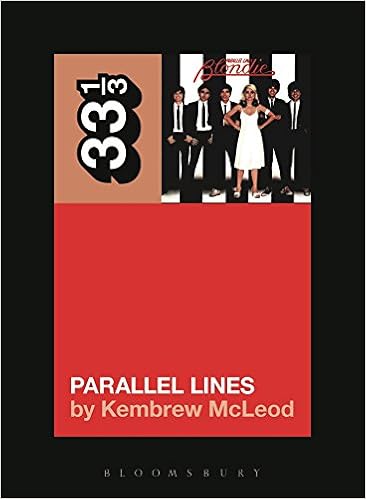
New York of the 1970s was one of those scenes; a thriving, vital hotbed of freaks, dropouts and weirdos getting artistic whilst the Big Apple rotted around them. It started roughly with the kinky subversion of Warhol and the Velvet Underground and would end up manifesting itself in a myriad of forms; Patti Smith’s punk poetry, the geek funk of Talking Heads, the rampant sleaze of the New York Dolls and the heads down ramalama racket of The Ramones. Even the musical forms which ended up being culturally dominant (disco and hip hop) began as the songs of the marginal. Blondie’s Parallel Lines is a document of that scene; a record of how it grew, evolved, splintered and eventually how it was refracted in one of the finest and most stylish pop albums of all time.

Very little of the book focuses on the album itself; perhaps only in terms of what Mike Chapman brought to producing the album and how remarkably the album was broken by the fourth single; a song buried halfway through side two. In modern times it’s insane to think that a song which still sounds like it should be an instant pop smash was almost sneaked out apologetically. It’s a wise move on McLeod’s part; he’s correctly divined that whilst Parallel Lines is a magnificent pop album what really makes it interesting is how it messes with what pop should be; you can enjoy Harry’s femme fatale persona as performance act or simply as an iconic pop star; you can enjoy the ridiculously infectious songs or enjoy the subversively provocative lyrics; you can enjoy the album or marvel at the sources it’s drawing on. It’s a melting pot of New York influences; punk, power pop, disco and they’d even stir in hip hop later on. In many ways they were as magpie as Bowie but playing with a 50s trash aesthetic rather than sci-fi and mysticism (they’re minor strands in Blondie’s music). Further parallels with Bowie come in Harry’s awareness of the power of image; the band’s at its strongest when Harry has control of the visual imagery. Harry and Bowie share an instinctive understanding of the importance of image and presentation in pop; something they were ahead of the game in as they broke through in the pre-MTV era. What’s really treasurable is how the book reminds us that it’s an underdog story; how no-one thought Blondie would make it let alone be the most commercially successful band of the scene.

The whole thing’s laced with the interviews from important people in the story; the band members themselves and those around the scene at the time. It doesn’t shy away from less glamorous aspects of the band’s story (the money troubles, the state of the area they lived in, the sex and drugs, Chris Stein’s illness) but it’s all covered compassionately and with proper context.  And that’s the triumph of the book; to put the band and album in context of the scene it came from; in its importance in the band’s history and the little tricks they were pulling beneath Chapman’s immaculate pop sheen. A sharp enjoyable tribute which fills in the details lost in the dazzle when the spotlight hit the glitterball.


(STANDARD DISCLAIMER – The copy I read was an advance eBook provided gratis by NetGalley in exchange for a fair and honest review).

Dance Songs '97


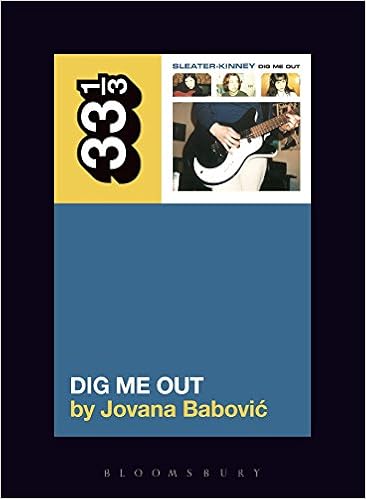
I love Sleater-Kinney; they’re one of the last bands for my generation that you could fall in love with, who could mean the world to you and who would who loved the fans as much as the fans loved them. They always seemed aware of the fan reaction and the political statement of being three women playing fast, often angry music. They seemed to want to be the feminist equivalent both the Sex Pistols and the writers of Sniffin’ Glue.  It’s a beautiful ambition. I love that the album Babovic has chosen for the 33 1/3 series is Dig Me Out; whereas Call the Doctor and All Hands on the Bad One feel more obvious choices Dig Me Out is where the ‘classic’ line-up coalesces and things began to take off for them commercially. It’s a portrait of a band on the cusp of their big artistic and commercial break; almost invariably it’s the most interesting point of any band’s career. Even Coldplay’s.

As with the best books in the series this is barely about the album itself; although the circumstances of recording are discussed as they’re important to the record’s mood Babovic wisely realises that the technicalities aren’t important and often the album itself isn’t either. It’s simply the cultural artefact that triggers everything; the eye of the storm. As with the last 33 1/3 I read (Blondie’s Parallel Lines) this is about putting the album into context; its roots, its reception and the consequences for the band and music in general. I’d perhaps have liked a little more on Riot Grrl (although I appreciate there’s not a great deal of room to discuss it a little more beyond depth beyond Bikini Kill would’ve been nice) but Babovic drills down to just why the movement made little impact outside its heartland of Washington state and the UK but Sleater-Kinney did. It’s perhaps a simple conclusion but it might have been interesting to see it linked to Nirvana and Cobain’s inability to marry his purist ethic to grand scale success.   Not comparing female rock stars to male stars is very much the point but equally the comparison could simply be made band against band. Riot Grrl wasn’t equipped to handle mass success but Sleater-Kinney’s willingness to meet mainstream press and the music business whilst maintaining their principles means they were. You can’t spread a message, no matter how worthy, with an insular attitude. My favourite part of the book remained the details of the interactions of fans and band; the late 1990s and early 2000s feel like the last hurrah of fanzine culture and it’s fantastic to see it detailed here. Hey Soundguy sounds like the DIY punk zines of the late 1970s; a love of music (not necessarily technique) combined with a willingness to expose the workings of the system.  It’s about artists genuinely interested in having a conversation with their audience rather than preaching at them; that’s my favourite kind of band and a reminder of just why I love what they mean as much as any individual song or album.

If there’s a minor fault it’s perhaps that Babovic lapses into dry academic tone occasionally but it’s not at the expense of clearly dealing with the issues surrounding the band; it’s clearly as much about using the language of rock criticism to communicate as the band were using musical language to get their point across. That very much feels like the right way to write a book about the band; it covers what makes the band important in a relatively small wordcount.

And now I’m off to play Dig Me Out loud and take myself back most of two decades. Driving you back to the album is always the best sign of a good book.


(STANDARD DISCLAIMER – The copy I read was an advance eBook provided gratis by NetGalley in exchange for a fair and honest review).

Monday, 9 November 2015

The Black Archive is opening...


So this is an upcoming thing...


Phil Purser-Hallard, one of the smartest people I have the pleasure of knowing, came up with a simple but brilliant idea for a range of books; in-depth studies of single Doctor Who stories by a bunch of talented writers with interesting things to say. I've got the pleasure of being included in the first batch of books with a piece on the episode that launched Doctor Who back to the heart of popular culture.  Think the Doctor Who equivalent of the excellent 33 1/3 books.

These are going to be magnificent.  Further details here and whilst you're there you really should open your virtual wallet for a few of Obverse's other fine books.

Thursday, 3 April 2008

33 1/3: Let's Talk About Love - A Journey To The Edge of Taste

That's it, I've blown my non-existent cool quotient already. Here's me blowing it further - it's one of the most interesting books about music you're likely to come across. But hey, if you stick with it through this you might even come back in future. And it's early days, so I haven't really established any expectations of what I'll blog about, so I might as well use the opportunity to blog about anything and everything. On with the show then...

I love the approach the 33 1/3 series takes. It's fairly simple - the writer takes a 'classic' album and takes an in depth look at it. No restriction on how they talk about the passion, but the editorial team appear to encourage a ' more personal the better' approach, and that's something I'd rather read than a standard band and/or recording history. I don't necessarily enjoy each book (the volume on R.E.M.'s Murmur turned me right off by attempting a clinical dissection of every aspect) but it's more than made up for by relative triumphs such as Bowie's Low or Meat Is Murder by The Smiths, which is far more about how fans related to The Smiths than a flat out review. And then this, for me their finest achievement.

If you're anything like me, you're wondering why a 'classic' album series goes anywhere near the Celine Dion ouevre - yep, in the late Nineties she was pretty bloody ubiquitous with godawful squalling ballads like Think Twice, the Titanic love theme abomination My Heart Will Go On and making a new generation relive the nightmares of previous ones with covers of Jennifer Rush's The Power of Love and All By Myself (those links, incidentally, come with an aural health warning). That's where the genius comes in - for all the column inches expended on cult favourites such as The Smiths or Radiohead, Dion's sales dwarf theirs into insignificance. Readers of Q, NME, Rolling Stone or Spin would rather cut their ears off than willingly subject themselves to her overpowering, turned up beyond 11 voice (one of Wilson's most insightful asides is his take on Dion's music as 'hair metal on oestrogen'). Well, unless irony is involved. So Wilson goes beyond the usual remit of music journalism and, without once breaking into the regulation music journo's sneer at the bovine masses, goes to find out exactly who's buying these albums and why. Oh, and why we Cool Kids can't bloody stand her of course.

It's clearly not for her public persona, which is largely bland bar an outburst about impoverished victims of Hurricane Katarina in New Orleans. She comes across as almost teeth grindingly nice, reassuring Elliott Smith before both performed at the Oscars, donating a cool million to those hurricane victims and, most reassuringly of all, not being sure that My Heart Will Go On was any cop when asked to record it. No, as Wilson concludes, it lies in her being deeply uncool and about as close to emotionally direct as you get in the music industry. Think about it, how few cool acts directly confront emotion but instead rely on the smoke and mirrors of metaphor. Irrelevant here, but importantly to me, it's that emtional directness that Russell T Davies has tapped into to gain Doctor Who a female fanbase and popularity undreamt of since the height of Dalekmania.

Wison also employs some dense cultural theory to good effect, employing studies of whether artistic or popular taste is scientifically quantifiable and proving that Dion hits plenty of the right buttons in popular taste, and follows that up by playing with notions of cool. It's not always comfortable for those of us who automatically equate Dion with uncool either - cool is, of course, one of the adman's favourite weapons to sell product. The Dion devotees are largely untroubled by such notions of cool, which perversely might make them cooler in real terms than the fans who provide the music press with the bulk of their readership. And her fandom's activities are uncomfortably close to those of any other online fans you care to name - there's fanfic and online confessionals reminiscent of fanboy/fangrrrl sites, fans who attend as many gigs as humanly possible and obsess over the minutiae of her back catalogue. They're just like us. And they don't care about what others think of their Celine love. Of course, this gets undercut when you see the ruthless marketing of Dion for various territories, the various strategies employed to ensure every country in the world buys her records (such as her recording in various languages, singing on film soundtracks or singing with local backing bands). Cool or uncool, the marketing execs will find a way to sell you product, which is a tad depressing. Still, it gives you something to admire Celine Dion fans for, we music press readers are the herd animals who don't know we're the herd.

A good friend of mine who died last year had My Heart Will Go On played at her funeral, naturally I thought of it at the time as something to be tuned out, but it left a hell of a lot of people blinking away tears. It's the sort of thing that makes you feel what 40s detective movies used to call a heel, it was as meaningful to her as any of my touchstone tunes are to me. Maybe I've been wrong all along. I can't say I'm ever going to enjoy a Celine Dion tune but I might not dismiss it with the mandatory thoughtless sneer. If this book can get someone like me, violently allergic to Dion as I am, to rethink such ingrained assumptions then it has to be classed as something of a triumph.